
From "Covering" to "Figuring Out”: Why Sensemaking in Science Instruction Is Non-Negotiable
For decades, standard science instruction followed a familiar script: introduce a vocabulary list, lecture on a formula or theory, perform a "cookbook" lab to confirm what was just taught, and test students on their ability to recall facts. In this traditional framework, science was presented as a fixed body of static knowledge to be memorized and covered.
The advent of the Next Generation Science Standards (NGSS) and A Framework for K–12 Science Education (National Research Council [NRC], 2012) fundamentally challenged this paradigm. Modern science education demands a shift in classroom culture: moving from learning about science to figuring out science through sensemaking.
To transform K–12 classrooms into communities where students act as scientists rather than passive recipients of information, curriculum design must lead the charge.
What Is Sensemaking, and Why Does It Matter?
At its core, sensemaking is the active, conceptual process where students work to figure out how the world works (science) or how to solve a practical problem (engineering). According to the National Science Teaching Association (NSTA), sensemaking requires four integrated attributes:
Anchoring lessons in real-world phenomena.
Engaging in Science and Engineering Practices (SEPs).
Leveraging student ideas as valuable assets.
Building Disciplinary Core Ideas (DCIs) through the lens of Crosscutting Concepts (CCCs).
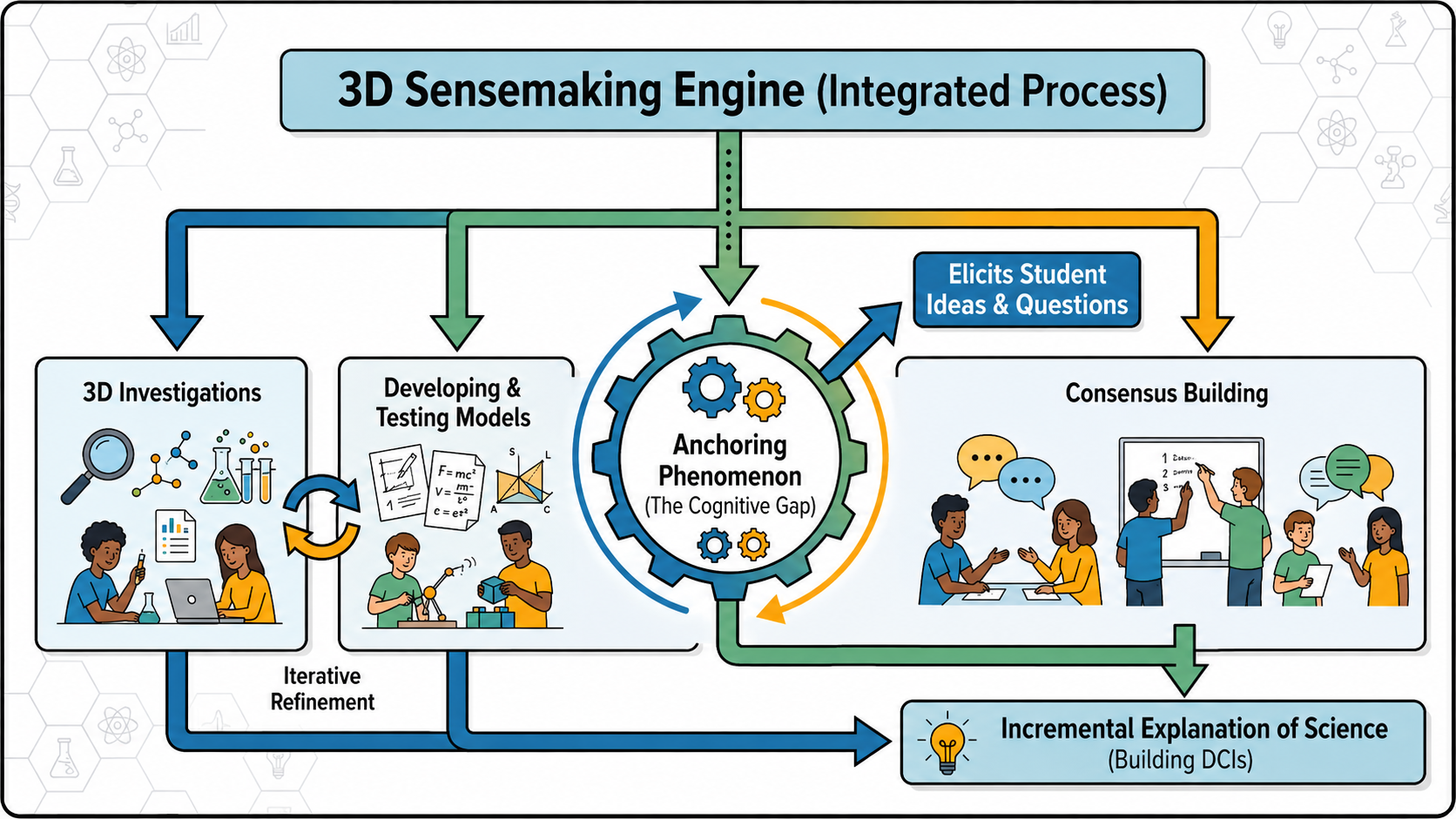
The diagram illustrates the Refined 3D Sensemaking Engine, a framework detailing how student questions about a real-world phenomenon drive a continuous cycle of investigation, knowledge integration, and model refinement to build coherent scientific understanding.
Research from A Framework for K–12 Science Education (NRC, 2012) underscores that knowledge is not passively absorbed; it is constructed through reasoning, evidence gathering, and collaborative discourse. When students encounter a puzzling phenomenon, they experience a cognitive gap. Closing that gap requires them to ask questions, construct mental models, gather data, and refine their thinking.
As highlighted in recent ASCD research, this shift transforms the classroom dynamic: rather than confirming what they already know, students engage in the "joyful search for sense" by working through authentic uncertainty (ASCD, 2026). Instead of asking, "Will this be on the test?" students begin asking, "Why did that happen, and how can we test it?"
The Engine of Sensemaking: Phenomenon-Based Storylines
How do we design curricula that sustain this level of intellectual engagement over weeks, rather than a single class period? The answer lies in phenomenon-based storyline curriculum design.
As detailed by Reiser, Novak, and McGill (2017), a storyline is a coherent sequence of lessons where each step is driven by the students' own questions that arise from building on earlier ideas. Traditional curriculum design is coherent to the teacher and organized neatly by chapter or topic (e.g., "The Cell," "Newton's Laws"). A storyline, by contrast, is coherent from the student's perspective.
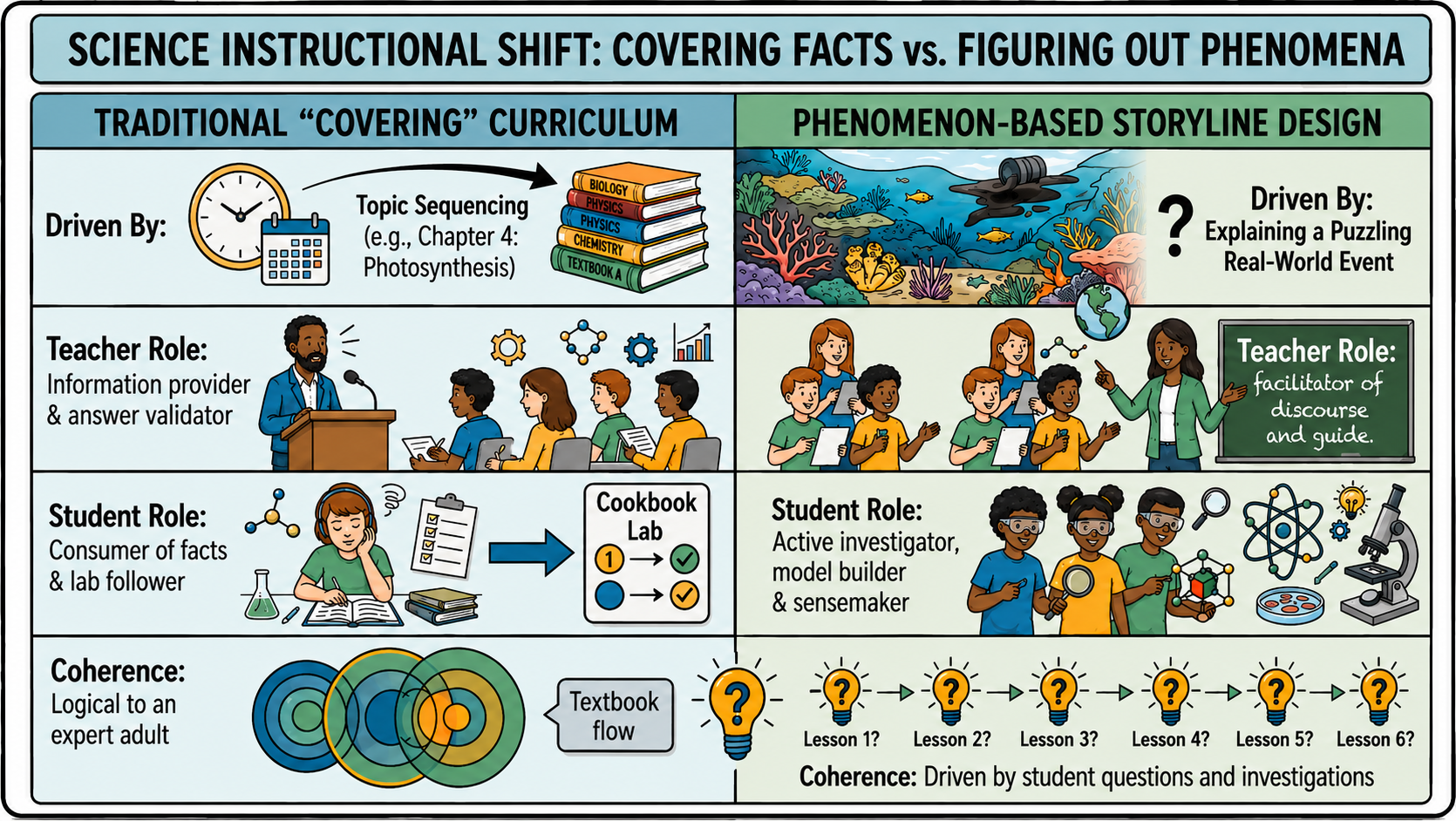
In a well-designed storyline, students do not simply complete activities because it is "what we are doing today." Instead, every investigation, reading, or simulation serves a clear, student-driven purpose: gathering evidence to answer a question raised in the previous lesson.
Key Principles of Effective Sensemaking Curriculum Design
Designing units that achieve authentic sensemaking requires intentionality at every level of curriculum development.
1. Anchor in High-Leverage, Accessible Phenomena
Not all phenomena are created equal. A flash-in-the-pan demonstration (like dropping a mint into diet soda) generates excitement, but it often lacks the depth needed to sustain multi-week investigations. High-leverage anchoring phenomena must be complex enough to require multiple core ideas to explain and culturally or experientially relevant to students' lives.
When students can bring their own lived experiences to bear on a problem, equity in the science classroom increases dramatically (Brown & Bybee, 2023; Penuel et al., 2018).
2. Prioritize Gaps Over Immediate Answers
Traditional curriculum rushes to resolve ambiguity, providing definitions before students have experienced the underlying concept. Sensemaking demands that curriculum developers embrace the gap. Units should intentionally position students in moments where their current explanatory models fail, prompting the need to invent a new test, re-evaluate data, or refine their conceptual tools.
3. Integrate 3D Learning Natively, Not As an Add-On
Sensemaking cannot occur if Science and Engineering Practices (SEPs), Disciplinary Core Ideas (DCIs), and Crosscutting Concepts (CCCs) are taught in isolation. Students must use practices (like modeling or data analysis) through the lens of a crosscutting concept (like systems or cause and effect) to construct understanding of a core idea. The practice is the tool; the DCI is the destination; the CCC is the framing lens.
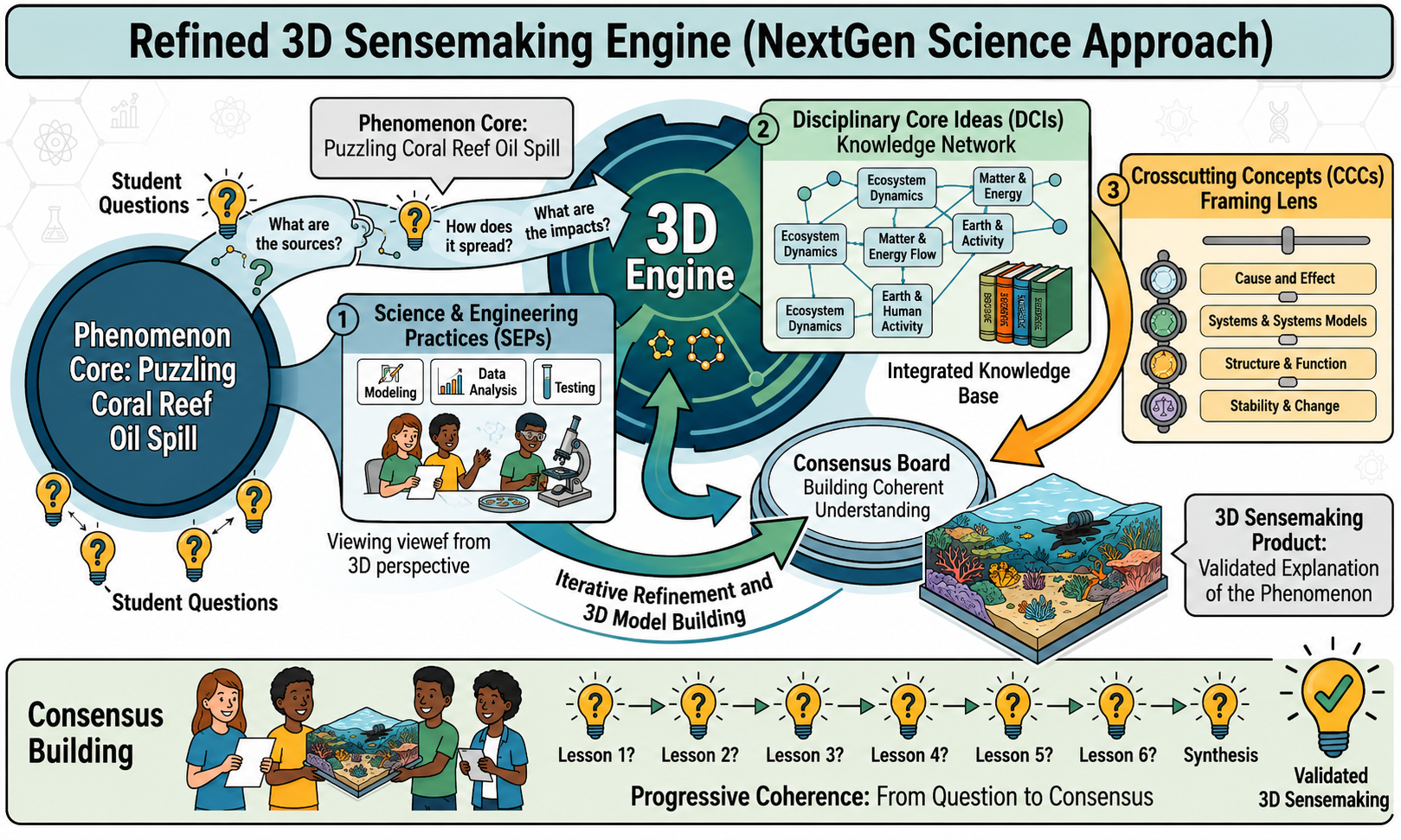
This diagram outlines a refined 3D sensemaking engine, where student-driven questions about a core phenomenon (a puzzle reef oil spill) fuel an iterative cycle of investigation using practices, content knowledge, and crosscutting concepts to achieve a validated explanation.
Beware the "NGSSified" Quick Fix: A common pitfall in modern curriculum design is taking a traditional, procedure-following lab and simply tacking a Claim-Evidence-Reasoning (CER) framework onto the end as a conclusion. Retrofitting a cookbook lab with a CER prompt does not equate to authentic sensemaking or alignment with the standards. If students are merely confirming a scientific fact they were told prior to the lab, writing a CER becomes an exercise in summarizing known answers rather than actively figuring out an unexplained phenomenon. Authentic sensemaking requires that the scientific argument or any explanatory model emerges naturally from a student's need to make sense of a puzzling gap in their understanding, rather than serving as a superficial add-on to a legacy activity.
4. Build Systems for Visible Scientific Discourse
Sensemaking is fundamentally a social enterprise (NSTA, 2023). Curricula must build in explicit structures, such as consensus boards, driving question boards, and iterative public modeling, that allow student ideas to be made visible, evaluated, and revised collaboratively over time (ASCD, 2026; Reiser et al., 2017).
Elevating Student Learning: The Path Forward
When we shift our curriculum development approach from designing content delivery systems to authoring trajectories for student sensemaking, the classroom transforms. Students cease to be passive observers watching a teacher demonstrate science; they become active investigators who own their learning journey.
The shift from "covering" to "figuring out" is not merely a change in instructional strategy: it is a commitment to fostering critical thinking, scientific literacy, and agency in every student. By grounding our units in rich, phenomenon-driven storylines, we provide the scaffolding required for learners to build deep, lasting conceptual understandings that stay with them long after the unit ends.
References
ASCD (2026). Sensemaking in Science. ASCD Education Leadership / Publications.
Brown, P. L., & Bybee, R. W. (2023). Promoting Sensemaking Through an Impactful Instructional Sequence. NSTA: The Science Teacher, 90(6).
National Research Council (NRC). (2012). A Framework for K–12 Science Education: Practices, Crosscutting Concepts, and Core Ideas. Washington, DC: The National Academies Press.
NSTA. (2023). NSTA Position Statement & Critical Attributes: Sensemaking in Science Classrooms. National Science Teaching Association.
Penuel, W. R., et al. (2018). Designing for Equitable Engagement in Science Practices. Journal of Research in Science Teaching.
Reiser, B. J., Novak, M., & McGill, T. A. W. (2017). Coherence from the Students' Perspective: NextGen Science Storylines. Next Generation Science Standards Design Principles.
